

Introduction:
Actionable insights on Talent Management and Employee Engagement to help businesses stay competitive—without compromising quality.
________________________________________
The Real Edge: People Strategy in a Competitive Market
Your people strategy stands as the ultimate sustainable competitive advantage in a market where product duplication occurs and price wars reduce profit margins. Organizations competing in competitive markets require more than operational efficiency because they need a thriving culture supported by high-performing and fully engaged talent.
Many leaders struggle to maintain equilibrium between investing in talent management and employee engagement alongside maintaining quality outputs and financial control.
You need to find methods to develop talent management and employee engagement strategies which avoid negative effects on quality outputs and financial control.
This discussion will present proven strategies that generate results while supported by business evidence and practical frameworks and tools.
________________________________________
Defining the Twin Engines—Talent Management and Employee Engagement
Before diving into execution, let’s clarify what these terms really mean.
Talent Management Isn’t Just HR—It’s Strategic Infrastructure
The complete set of actions and operational methods for attracting suitable candidates at optimal times makes up Talent Management. The proper implementation of this practice creates organizational agility while strengthening employee bench strength and securing future business success.
Key components include:
• Strategic workforce planning
• Competency-based hiring
• Skills gap analysis
• Career pathing and succession planning
• Learning & development programs
Employee Engagement—Your Internal Competitive Advantage
Employee Engagement surpasses satisfaction levels. People show their emotional dedication toward organizational goals and values when they demonstrate commitment. Engaged employees:
• Drive higher productivity
• Deliver better customer experiences
• Stick around longer (lower turnover)
• Bring innovative ideas to the table
People who are engaged with their work serve as driving forces that propel organizational momentum forward.
________________________________________
The Business Case for Getting It Right
Competitive market companies must avoid both unengaged staff and incorrect talent placements. The following results occur when organizations successfully implement talent and engagement strategies:
Performance Gains That Move the Needle
Gallup reports that organizations which achieve top-quartile employee engagement performance levels generate superior results than those with bottom-quartile performance by:
• 21% higher profitability
• 17% higher productivity
• 41% lower absenteeism
Research from McKinsey demonstrates that organizations with exceptional talent strategies achieve 2.2 times greater revenue growth than their competitors.
________________________________________
The Execution Playbook—How to Build Smart, Scalable Talent Systems
Step 1 – Start with Strategic Workforce Planning
You wouldn’t build a factory without a blueprint. The same goes for your workforce.
Begin by determining the following information:
• Which business capabilities will your organization require during the upcoming 12–24 months?
• What roles maintain mission-critical functions versus operational requirements?
• What skills do your workforce currently lack?
Create a talent map by visualizing your present workforce capabilities against your projected capability needs. The guide will help you decide which positions require hiring and which need upskilling.
Step 2 – Rewire Hiring for Fit and Future
Recruit candidates who demonstrate both compatibility with your organization and mental adaptability.
Smart hiring practices include:
• Role-based assessments (not just interviews)
• Cultural fit evaluations
• Structured onboarding programs
• Internal mobility opportunities
The front-line leaders who work directly with employees hold the actual power to shape performance outcomes.
Step 3 – Elevate Learning & Development
Forget generic training. L&D becomes strategic by directly connecting to business objectives.
Devote your efforts to:
• Microlearning for just-in-time knowledge
• On-the-job learning, mentorship, and shadowing
• Technical upskilling aligned with future roles
• Soft skills for leadership, communication, and agility
The 70-20-10 learning model operates as follows:
• 70% experiential (projects, rotations)
• 20% social (peer learning, coaching)
• 10% formal (courses, seminars)
Step 4 – Build a Culture of Recognition and Feedback
People seek employment for reasons beyond financial rewards because they need appreciation along with progress and meaningful purpose.
Establish recognition practices that both happen in public settings and focus on specific employee behaviors.
• Publicly celebrate behaviors that reflect your values
• Train leaders to give real-time feedbackThe following actions will be implemented to enhance employee engagement:
• The system enables recognition between peers.
The project should include feedback loops as a standard practice.
Step 5 – Listen Intently and Act Decisively
Engagement functions as a continuous process that requires mutual interaction between parties. The organization can identify upcoming issues by using employee listening mechanisms.
• Pulse surveys with fast turnaround
The organization should conduct stay interviews instead of waiting for employees to leave.
• Open forums and Q&A town halls
• Anonymous suggestion boxes
After receiving feedback employees should take action.
________________________________________
Real-World Case Example – Finance Firm Reinvents Engagement
The GCC financial services company faced high employee turnover and poor morale levels despite providing competitive pay and benefits to their staff members. After a rapid diagnostic, they realized:
The managers at the organization lacked training to effectively connect with their employees or develop their professional skills.
Promotion opportunities lacked clarity and employees felt they received unfair treatment.
The organization faced growing skill deficiencies mainly regarding data and digital abilities.
What they did:
The organization introduced a leadership development program that trained every middle manager.
The organization restructured their promotion system through transparent criteria implementation.
The organization established a digital training facility to teach employees data literacy alongside AI tool proficiency.
The organization introduced quarterly “Ask Me Anything” CEO town hall meetings.
The organization established an employee recognition program which linked to company values.
The results achieved after 12 months included:
The employee engagement scores showed a 24 percent increase.
The organization saw a 31 percent decrease in employee voluntary departure rates.
Internal promotions rose by 45% throughout the company.
The improvement in client satisfaction metrics reached 18% levels.
Their core insight? The strategic implementation of these two variables creates a positive relationship between engagement and performance.
________________________________________
The Approach Requires Adaptation to Meet Competitive Market Needs
Your talent management strategy needs to remain dynamic because you operate in demanding fast-paced market sectors which include technology and finance alongside retail and construction.
Businesses operating in competitive markets need to focus on the following priorities for Talent Management and Employee Engagement.
Agility Over Bureaucracy
The length of talent acquisition cycles eliminates innovation. The organization should streamline its processes to give teams the authority for making rapid personnel decisions.
Data-Driven Decision Making
The organization should utilize HR analytics to track engagement metrics alongside retention data and performance results beyond compliance metrics.
The hiring process costs should be compared to the return on investment for each candidate selection.
The risk assessment for team member burnout should be evaluated by examining which groups show high susceptibility.
You should examine performance reduction areas together with their underlying causes.
Strong Middle Management
The primary element which affects worker satisfaction comes from their immediate supervisor rather than from HR departments. Training managers should focus on executive development rather than parental supervision.
Purpose Alignment
The workforce seeks more than basic perks when selecting new opportunities. The employees need to feel that the mission means something to them. Organizations should infuse purpose throughout every phase of their work beginning with onboarding and continuing through daily objectives.
________________________________________
TL;DR: Key Takeaways for Busy Leaders
These essential strategic actions will have the greatest impact:
The organization should approach talent strategy with equal attention to business strategy.
Teams that are not engaged silently destroy growth while disengaged teams decrease profit levels.
Middle managers serve as your main organizational strength so make strategic investments in their development.
Data should replace instinctive decisions to execute strategic hiring and development and retention strategies.
High-pressure markets depend on culture as their operational glue rather than its being merely decorative.
________________________________________
Final Thought:
Success in competitive markets does not come from exhaustion of staff or frequent personnel replacements. Great people can achieve excellence when you create an environment which removes obstacles while preventing exhaustion and preserves organizational purpose.
Begin immediately. The current talent pool retention will become the basis of your future success.
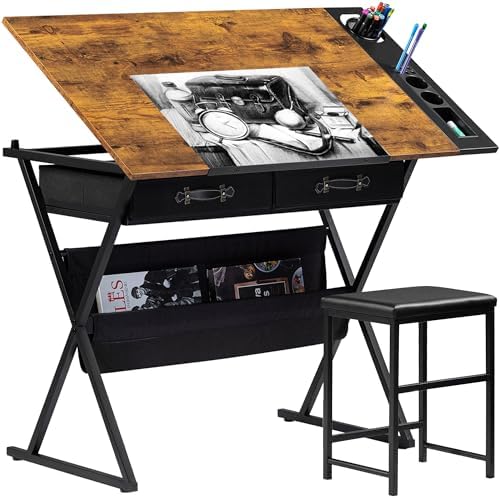
- Effortlessly Control Angle: This adjustable drafting table tilts from 0-90°, allows to adjust as needed. It serves both …
- Reliably Constructed: This drawing hobby table is crafted with a heavy-duty metal frame and a 12mm thick MDF, ensuring a…
- User-centred Storage Design: The drafting table with storage features two non-woven fabric drawers and a fabric storage …

- [Welcome Power Outlets]: Invite this narrow console table to inspire your life! 2 outlets, 1 USB Port and 1 Type-C port …
- [Space Artist]: Your sofa back is empty? Let this entry way home table give you space surprise. Set it up in the narrow …
- [Functions Can Be More]: Thought this Long table could only be a sofa table to place plants, scented candles? Think agai…

- VINTAGE DRAFTING TABLE: Classic antique design and finish that is reminiscent of turn-of-the-century furnishings; Perfec…
- BUILT-IN PENCIL GROOVE WITH PENCIL LEDGE: Designed with a built-in pencil groove and 24″-wide pencil ledge for storing w…
- ADJUSTABLE WORK SURFACE: 36″ W x 24″ D main work surface features a unique platform that adjusts from a flat surface to …